Powderpost beetle crawlspace remediation addresses the irreversible destruction of load-bearing timbers caused by wood-boring larvae feeding within damp crawlspaces. In coastal environments, high ambient humidity…
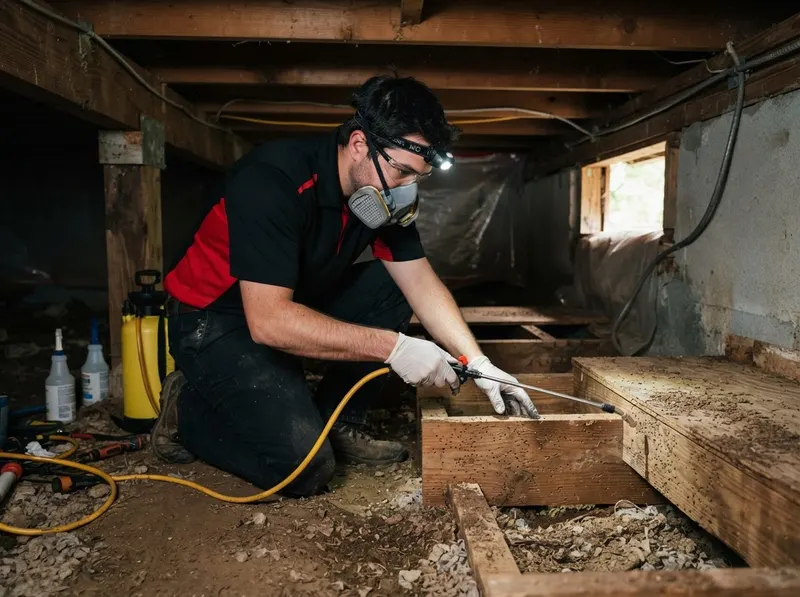
Powderpost beetle crawlspace remediation addresses the irreversible destruction of load-bearing timbers caused by wood-boring larvae feeding within damp crawlspaces. In coastal environments, high ambient humidity accelerates wood moisture equivalent levels past 16%, creating an ideal breeding habitat documented by the Clemson University Cooperative Extension for wood-destroying beetles. Unchecked infestations reduce heartwood pine, oak sleepers, and historic joists into a fine, talc-like frass powder. Surface fogging leaves internal larval galleries untouched; lasting structural integrity requires direct liquid borate absorption across the cellular structure of the wood as guided by the USDA Forest Service research on timber preservation. Homeowners observing round emergence pinholes ranging from 1/32-inch to 1/8-inch across crawlspace framing require direct subsurface remediation rather than cosmetic pest perimeter sprays.
Subterranean crawlspace geometry across Charleston County demands precise chemical targeting. Foundations in low-elevation zones like South of Broad, Harleston Village, and Radcliffeborough frequently feature original heart pine framing set over wet soil footings, whereas structures in West Ashley, James Island, and Johns Island often exhibit encapsulated or vented foundations susceptible to chronic ambient dampness. Chemical penetration standards established by the American Wood Protection Association mandate applying disodium octaborate tetrahydrate formulations to unsealed structural lumber, allowing the active mineral salts to diffuse through moisture gradients directly into active larval feeding channels. When moisture readings exceed 20%, structural timbers risk secondary colonization by decay fungi, necessitating integrated moisture management protocols aligned with EPA pesticide application safety baselines.
Timber thickness dictates application methodology. For dimension lumber measuring 2x8 inches to 2x12 inches common to Wagener Terrace and Daniel Island builds, topical high-pressure saturations of systemic borates penetrate up to 0.75 inches into the grain, neutralizing larvae upon contact. For massive historic hand-hewn beams exceeding 6x6 inches found in the Downtown Historic District, pressurized internal gallery injection is deployed via precision check valves. Technicians evaluate ambient crawlspace dew points using standards derived from the National Institute of Standards and Technology to ensure the chemical barrier crystalizes without leaching into native soils. This approach replaces indiscriminate whole-structure sulfuryl fluoride fumigation, which requires home tenting and temporary vacancy, with localized, odorless inorganic salts classified under OSHA occupational health parameters.
Effective crawlspace beetle management interfaces directly with the South Carolina Department of Health and Environmental Control drainage guidelines and the structural standards outlined by the International Code Council for existing buildings. Remediation plans also adhere to the preservation methods recognized by the National Park Service Technical Preservation Services, ensuring structural stabilization without altering historic timber surfaces. Structural integrity is confirmed by validating wood core density, halting larval emergence cycles, and establishing permanent mineral deterrence across all accessible foundation members. EmberRoot Bug Removal can be reached directly at (843) 268-6996 to evaluate structural crawlspace wood.
Every job gets a firm, written price after a free on-site visit.
Tell us about your powderpost beetle crawlspace remediation job in Charleston and we'll send a clear, written quote, usually the same day.
 EmberRoot Bug Removal