Coastal salt marshes along the Ashley River and Charleston Harbor produce continuous biological vectors that surface-level canister sprays cannot interrupt. Biting midges, commonly cataloged by the Clemson University…
Coastal salt marshes along the Ashley River and Charleston Harbor produce continuous biological vectors that surface-level canister sprays cannot interrupt. Biting midges, commonly cataloged by the Clemson University Cooperative Extension, require saturated mud and decaying organic detritus to incubate their larvae. In historic areas such as the Downtown Historic District, South of Broad, and Harleston Village, high ground moisture accumulates under historic brick piers and crawlspaces. Standard synthetic pyrethroids applied merely to low grass blades wash away during tidal inundations and heavy coastal rain events, leaving structural perimeters unprotected against aggressive crepuscular swarms.
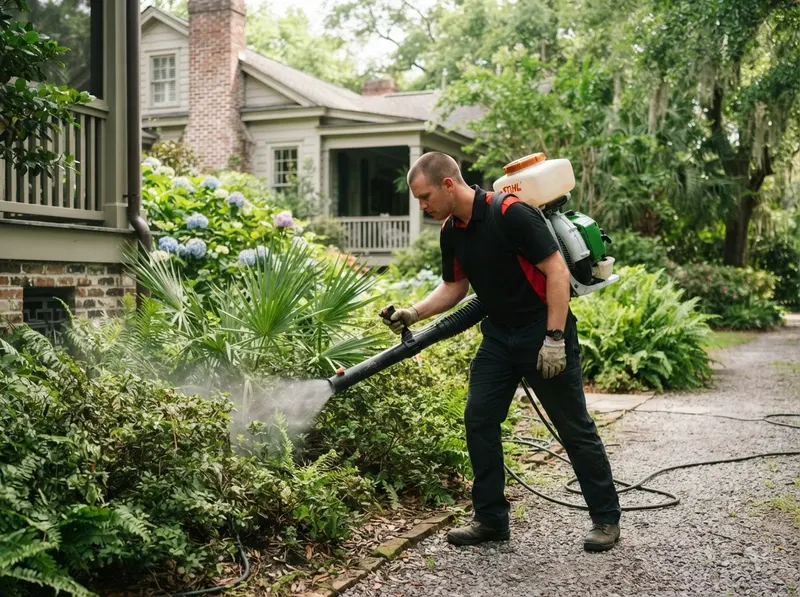
EmberRoot Bug Removal establishes subterranean nest disruption and vegetative interception zones calibrated to local humidity tables published by the National Weather Service Charleston Office. Technicians deploy targeted, low-odor insect growth regulators alongside biological control agents like Bacillus thuringiensis israelensis, an active microbial ingredient reviewed by the United States Environmental Protection Agency. Rather than releasing untargeted chemical fogging into ambient sea breezes, technicians inject treatments into moist soil interfaces, mulch borders, and dense understory vegetation where adult dipterans rest during high midday temperatures. Field operations strictly conform to pesticide handling regulations enforced by the Clemson Department of Pesticide Regulation.
Waterfront parcels on Daniel Island, Johns Island, and James Island border extensive spartina grass wetlands that sustain biting midge broods. Properties situated near drainage basins, such as marsh cuts adjoining West Ashley or tidal ditches around Wagener Terrace and Radcliffeborough, require dual-action perimeter defenses. Protocols align with watershed preservation parameters established by the South Carolina Department of Health and Environmental Control. Technicians isolate vegetative shelter corridors while strictly shielding critical coastal drainage habitats from contamination, consistent with resource protection directives maintained by the South Carolina Department of Natural Resources and the Charleston County Public Works stormwater division. Further vector data documented by the Centers for Disease Control and Prevention underpins this targeted strategy, which eliminates insect populations without saturating residential grounds in aromatic neurotoxins. Homeowners can reach EmberRoot Bug Removal by calling (843) 268-6996.
Every job gets a firm, written price after a free on-site visit.
Tell us about your biting midge and mosquito perimeter interruption job in Charleston and we'll send a clear, written quote, usually the same day.
 EmberRoot Bug Removal